
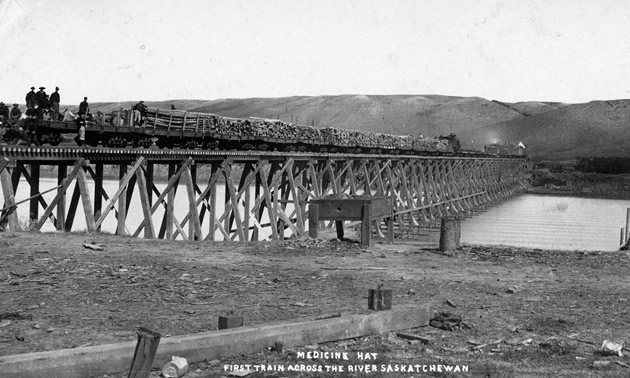
Medicine Hat’s story begins as a rapidly growing Canadian Pacific Railway (CPR) town. The location was a corporate choice simply because of its position along the South Saskatchewan River. The cliffs along the river allowed for a more gradual grade for the rail to cross the river and valley and proceed out the other side. Medicine Hat was also chosen by the CPR as a divisional point, contributing to the community’s quick growth.
“For the first few years of the community, until 1898, Medicine Hat was run as a CPR company town,” said Philip Pype, an archivist at the Esplanade Arts and Heritage Centre. “In 1898, after much debate between CPR and the local community, Medicine Hat officially became a town.” Medicine Hat elected its first town council, and the growth of the town flourished. At the time, there was well over 1,000 people living in the area.
The name “Medicine Hat” predates the town itself. “There are a lot of different variations of the legends on how Medicine Hat got its name. It’s always been debated which one is the actual story,” said Pype. The important similarity between these legends is the First Nation roots which are still apparent in the town today.
For visitors wanting to learn more about the history of Medicine Hat, the Esplanade Arts and Heritage Centre is the place to start. The complex is the new home of the city’s museum that dates to 1948. The collecting of historical artifacts and stories was very community-based, and now the centre is operated by the City of Medicine Hat.
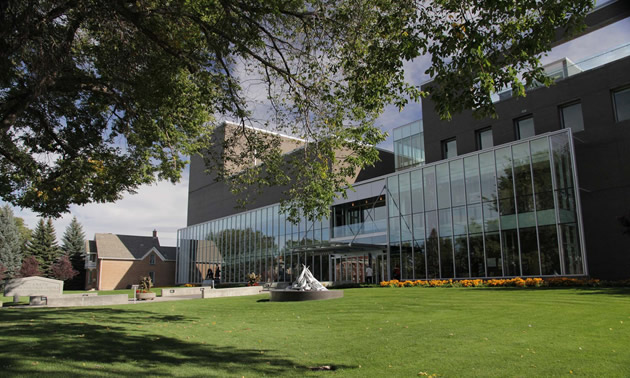
“A group of local volunteers met at Hector Lane’s house, the mayor of Medicine Hat at the time,” said Pype. The group decided that they needed to start collecting the stories of Medicine Hat. “As they started interviewing people, the people brought along photographs and artifacts," he said. "They had these stories, but they also had these historically significant items and documents.” These artifacts, photographs and stories comprised the first museum located in a log cabin in Riverside Park.
Since 2005, the Esplanade Museum shows visitors the chronological story of Medicine Hat’s settlement. “The main museum exhibit is Medicine Hat: Frontier to Gas City,” said Pype. “It is an exhibit that follows the history of Medicine Hat, starting with First Nations and Metis who have certainly continued to be a part of this community.” This exhibit follows the city’s growth through the arrival of the Mounties and the railway, the growth of the community, its businesses, industries, ranching and community life. “Various stories, artifacts and images are put together to tell the story of the community,” Pype said.
The lost town of Robsart
The Esplanade Museum often features temporary exhibits. This summer, one must-see exhibit will focus on the nearby prairie town of Robsart, Saskatchewan. “One of the things that makes this community interesting is there was a professional photographer in the community at the time named John Asplund,” Pype said.
Robsart was founded in 1909. The Government of Canada actively sought settlers for the town to complement the branch line the CPR was planning. Asplund’s photographs “capture its struggles, its triumphs, the coming of the rail and community events,” said Pype. It showcases the prairie settlement experience. Unfortunately, “the community wasn’t able to maintain itself,” he said. There is still a community Southwest of the Cypress Hills, but it isn’t much of a town site anymore. The Esplanade offers a glimpse into the prairies’ past.
GETTING TO KNOW WILLIAM COUSINS
Although the founding of Medicine Hat was a collective—and originally corporate—effort, William Cousins is a notable figure who can be credited with some of the early settlement.
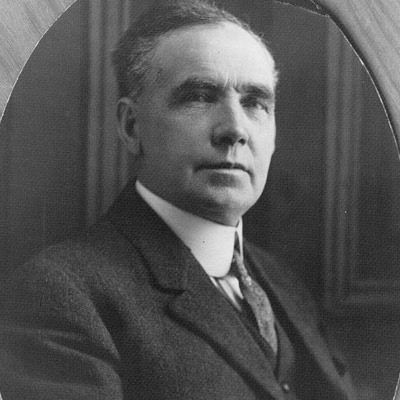
Cousins arrived in Medicine Hat in 1883—before the railway. He was one of the first merchants in the area. He set up his tent at Riverside Park, which is still a central location in the city. Cousins also operated real estate and ranching businesses and was the Mayor of Medicine Hat in 1907-1908.
Among several other accomplishments, Cousins also owned two newspapers and wrote a column for the Lethbridge Herald. His February 1, 1938, article tells the story of his arrival: “…we were at the top of Porter’s Hill, looking down on what is now the city of Medicine Hat. A glorious site—the trees on the banks of Ross and Seven Persons Creek were just coming into leaf and looked good to us after our long journey over the bald prairie.”