
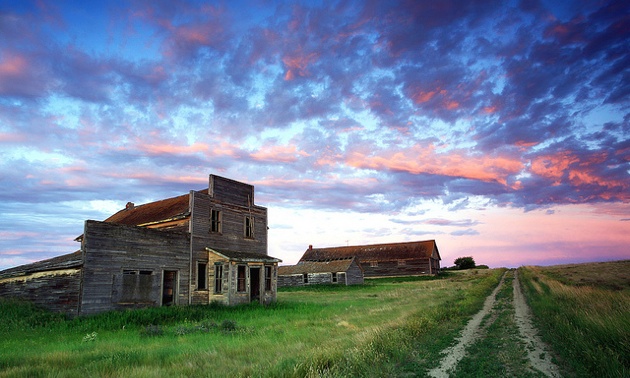

It’s 4:45 am and my body is telling me in no uncertain terms to keep sleeping. But I’ve hit snooze twice and, peeking out of my tent, I see the eastern sky exploding with colour. It’s time to move. Conditions are ripe. And, after traipsing around this classic Saskatchewan ghost town for two hours, I’m rewarded with some dramatic prairie images I’ll be proud of—and sell—for years to come.
Unquestionably the life of a “serious” landscape photographer demands some discipline. Cold mornings, long and lonely drives, sleep deprivation, it’s all part of the program. Of course, when it’s all said and done, photographing the natural world—or anything else, for that matter—is richly rewarding. Unquestionably, some of my fondest memories and most powerful experiences have been “out there,” photographing the beautiful world we live in.
Chances are you too love taking great images. But if you’re like most budding photographers, you’re often disappointed with the results. Don’t worry, the pros suffer many disappointing moments as well. Some of the common mistakes? A blown-out sky. Soft focus. A tilted horizon line. Underexposure. Inaccurate colours. Thankfully, there are also numerous ways to get it right. And, as you know, when you do, the feeling is euphoric and addicting! Here are a few key tips to make sure you leave a location proud to be a photographer.
Shoot in good light
It’s been said a million times before, I know, but shooting in the early mornings (yes, that sometimes means getting up at 5:00 a.m. or earlier) and late evening, when golden, low-angled light provides beautiful shadows and detail, is critical for good outdoor photos. If you really want nice photos, especially nature and landscapes, avoid the harsh, midday light at all costs. And just a simple tip for shooting people—get them in the shade!
Know how to use your equipment
“Wow, you must have a really good camera,” is a line I often hear. While somewhat insulting, the comment is always well intended. It’s just, well, kinda ignorant. Having a good camera is somewhat important, but it’s more important that, regardless of what you’re using, you know how to use it. Point and shoot cameras can produce stunning results, too, especially if the operator knows how to compose, adjust exposures, work the settings to accommodate the subject best, nail the focus, etc.
Learn how to edit your photos
A lot of it comes down to personal preference; however, at some level you’ve got to have some skills and some discipline when it comes to managing your files and doing the bare essentials in terms of processing. Things like cropping, adjusting the white balance (i.e. snow should not be yellow), and fixing crooked horizon lines are essential skills.
Be selective, take your time, and compose great images
Contrary to popular opinion, having a beautiful poplar branch in the foreground does not make for a great composition. A branch in the foreground is called a distracting element. However, using leading lines—things like shorelines, winding roads, cloud formations, etc.—can be a powerful way to lead the viewer’s eye into the scene and produce a winning image. Take your time. Think about what you’re trying to achieve with the shot. Avoid too much boring foreground. And only shoot when you really believe you have the right elements in place.
Use the rule of thirds
Placing your subject right in the middle of your image will usually produce a boring, static image. Use the full frame. Divide your frame into thirds and position your subject on one of those lines. Then find leading lines to draw the eye to that location on the image. Then, if you’ve got good light and a compelling subject, you’ve got an image!
Do your research
The best images are typically made when a photographer does his/her homework. In other words, don’t waste your time photographing a scene during a time or season when it doesn’t look good. Go back, again and again, when it does look good.
Use filters
Polarizers are great filters to use if you want nice blue skies in your photos. Gray neutral density graduated filters are also essential if you want to keep the colour in your skies and still get a nice exposure with details visible in the foreground. If you don’t know how to use them or where to get them, do some investigating. The Internet will tell you everything you need to know about filters with just a few clicks.
Practice makes perfect
There is no such thing as producing consistently amazing imagery if you don’t get out there and practice your craft on a regular basis. Photography is like anything else. That is, if you put some time and effort into it you will be rewarded. Now hit the road and shoot!
Andrew Penner is a freelance writer and professional photographer living in Calgary. Visit him at www.andrewpenner.com or contact him at [email protected]