
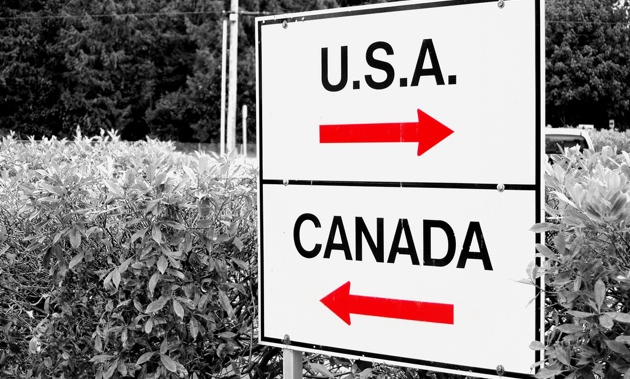



Just the other day, I got an email from a friend with a warning that snowbirds need to be aware of more stringent tracking and enforcement of rules on residency. Up until now, even though we presented identification at the U.S. border when we entered the States and to Canadian Border Service when we returned to Canada, the two countries had no formal way of sharing this information. Starting June 30, a new system will be introduced that gives both countries real-time access to residents’ entry and exit information.
I always thought that our time out of the country was aligned with the calendar year, but that is not true. It is based on what they call a “rolling 12-month period.” This means that the 182 days (six months) residents are allow to be in the other country depends on their travel dates and can overlap from one year to the next. For example, if we return to Canada from the U.S.A. on April 10, 2014, to accurately calculate our time in the States, we need to consider all the time we spent from April 10, 2013, to April 9, 2014—and that includes short shopping trips over the border.
So what happens if we over stay our welcome?
Overstaying the six-month residency rule can result in losing your residency status. Losing residency status can have unwelcome consequences.
- Provincial health care insurance is dependent on residency. If residents lose their residency status, they could lose their access to provincial health care.
- The resident can be banned from entering the U.S. for a period of from 3 to 10 years.
Tax-wise, if residents loses their resident status:
- They can be subject to a departure tax on gains from disposal of assets.
- They can be considered a U.S. resident and subject to tax on worldwide income.
- Everyone who is in the U.S for more than 182 days over a three year period is expected to fill out the Closer Connection form and send it into the IRS before June 15 the following year. This Form 8840 is available on the IRS website. (URL for IRS Conditions for a Closer Connection to a Foreign Country.)
A Canadian Press report on March 29 said there has been an effort in the U.S. to extend the six-month residency provision, but like so many pieces of government legislation, it has become bogged down in the system.
References and resources:
Globe and Mail
National Post
Canada Revenue Agency’s guide on Canadian Residents Going Down South