

For the RV enthusiasts who enjoy dry camping or boondocking, the addition of a solar panel package is very beneficial. The prices have become more affordable and there are many choices available from 12 volt, 24 volt, flexible and portable folding panels.
Most RVs are designed to work primarily with 12 volt DC power excluding items like microwaves or air conditioners. Installing a solar panel or panels will keep the deep-cycle batteries fully charged when no other electrical power source is available for folks who like to explore off-grid locations and the “gentle” charge rate can save on battery replacement costs.
Photovoltaics (PV) is the technology of converting sunlight to electricity via solar cells. The panels are basically made from wafers of silicone with an anti-reflective material, conductor strips, metal backing and sturdy framing. The panel will usually have from 30 to 36 cells connected in series, with each cell producing about 0.5 volts. Its primary function is to charge batteries.
The two most popular types of solar modules are the monocrystalline and the polycrystalline units. The monocrystalline module will have about a five per cent greater efficiency rate and is slightly better in high temperatures or minimal shading. The polycrystalline will usually cost less in that the manufacturing costs are lower.
Components of a solar package
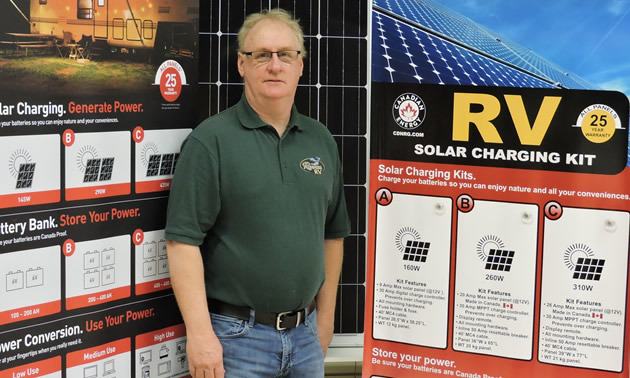
The common solar panel package will consist of the panel or module, the mounting hardware, wiring, charge controller and a fuse. Many RV dealerships will have prices that include installation.
The charge controller is a very important part of the solar package, primarily designed to protect the batteries from overcharging and prevent reverse flow at night when there is no voltage being produced by the panel. Depending on the model, they will have up to four stages of charge rate and will display battery voltage and panel amps when charging. The charge controller can be a PWM (Pulse Width Modulation) or a MPPT (Maximum Power Point Tracking) unit. Although the PWM does have limitations, it will cost less and still provides satisfactory charging functions. The MPPT will convert or maximize excess panel voltage to higher charging amps and can boost charge efficiency by about 30 per cent.
Sizing a system will involve three factors. You will need to calculate your daily average power consumption, how much panel wattage is required and how much battery capacity will suit your needs. There are many worksheets available on the Internet to help with these calculations.
Solar panels are most efficient in direct sunlight but can produce power even at a sun angle of five per cent or slightly overcast days. The panels are usually mounted flat on the RV roof but you can purchase a tilt mount to improve sunlight collection and panel efficiency by as much as 40 per cent.
An RV panel package can increase the value of your RV by adding a self-sustaining power source to keep the batteries charged. You can add more panels or remove the entire system to be installed on a newly purchased RV. It’s like having a power company that you can control.
For more detailed information on RV solar power, check the Runners RV website and Facebook page for upcoming seminars on solar power with the addition of related components like inverters, transfer switches and battery selection.