
Movies and the U.S. Cavalry
The movie industry often reflects history as well as makes history, especially when it comes to the topic of the U.S. cavalry or soldiers on horses. Hollywood quickly realized the romance of this historical period, making over 50 Western movies featuring the cavalry, including Fort Apache (1948), She Wore a Yellow Ribbon (1949), Rio Grande (1950), A Distant Drum (1964), Dances With Wolves (1990), Geronimo: American Legend (1993) and Buffalo Soldiers (1997). In these movies, the U.S. Cavalry or bluecoats always came to the rescue and saved American civilization from the savage Indians. The truth, of course, was very different.
Limits on liberty
Americans often boast that they are the freest country in the world. They even have the word liberty inscribed on their coin money and the word is found in both the Declaration of Independence and U.S. constitution. Upon visiting Fort Huachuca in Arizona, I discovered that liberty or freedom is not absolute. My only interests were the two museums and the African American Buffalo Soldiers.
My wife and I were denied entrance because we were not Americans and considered a security risk. We are Canadians! The reason is 9-11 and that the fort remains an active military base, being the headquarters of the Strategic Command and Army Intelligence Center as well as the base for the Army Network Enterprise Technology Command or NETCOM.
Despite this personal setback, Fort Huachuca remains an interesting topic.
B Troop ceremonial unit
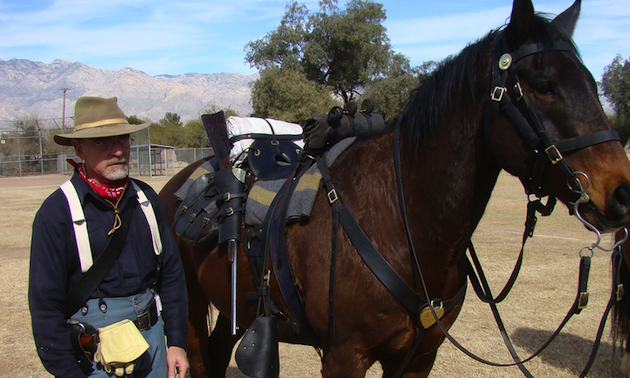
My interest in Fort Huachuca, found on the National Register of Historic Places, started with a visit to Fort Lowell in Tucson, the original American fort built in 1873 when the Americans obtained Arizona from Mexico. Performing at Fort Lowell was the B Troop of the Fourth U.S. Cavalry (Memorial), now stationed at Fort Huachuca, a small town near Sierra Vista, Arizona. B Troop performs at fairs, rodeos, parades and exhibitions. Their show is hands on, allowing the public to pet the horses, question the soldiers and examine guns and field equipment. The show concludes with a cannon demonstration and riding drills, much like the RCMP Musical Ride.
The U.S. Cavalry
As the Manifest Destiny expanded west, Americans came into conflict with the native peoples from Montana to Arizona. That made the U.S. Army, especially the cavalry, responsible for law and order on the frontier. Since the cavalry was mobile, it established 40 forts in Arizona alone. When a fort no longer served the purpose, the army moved locations. Cavalry forts were not constructed with massive wooden walls and guard towers, as depicted in western movies, but were more like small communities.
The cavalry had to remain mobile and not confined behind fortified walls to be effective. With fast horses, a Colt .45 single action revolver and a Winchester rifle and the cavalry was a formidable military force. Throw in a few cannons and the Indians were outmatched.
Buffalo Soldiers
Contributing to the reputation of the cavalry were the Buffalo Soldiers, an all-African-American regiment formed in 1866 following the Civil War. Four regiments—the 9th, 10th, 24th and 25th—were created, with the 10th Regiment stationed at numerous forts in the southwest. They distinguished themselves in the Apache Wars (1871-86) against Cochise, Vittorio and later Geronimo. It was the Apache who called them buffalo Soldiers because of their black skin, curly hair and tendency to fight like a cornered, wounded buffalo.
In addition, the soldiers guarded stagecoach lines and water supplies, built roads and telegraph lines, escorted wagon trains and protected settlers and miners. It was not easy for African American soldiers, subject to segregation, racial discrimination and indifference from white officers. For their efforts, 13 enlisted men and six officers were decorated with the Medal of Honor for bravery and courage in the line of duty, as was the entire 10th Regiment.
Remains of forts
Only nine significant cavalry forts remain today in Arizona: Fort Apache, Fort Bowie, Fort Defiance, Fort Grant, Fort Lowell, Fort Verde, Fort McDowell, Fort Whipple and Fort Huachuca. What remains of most forts are a few old buildings, officers’ quarters, foundations, barracks and a parade ground. Fort Verde, Fort Lowell, Fort Apache and Fort Bowie are worth a visit, with museums and visitors centres explaining their history.
Any foreign national, which includes Canadians, wishing to visit Fort Huachuca should first contact the City of Sierra Vista Public Affairs Office to arrange for an approved military escort. The office can be reached by emailing [email protected], or by calling (520) 439-2167.