
Marshall Carroll may not have finished first in his race for Canada’s Smartest Person, but after being selected from thousands of applicants, he can now add to his resumé that he’s definitely one of the top four.
Featured as one of the four contestants on the CBC Television special Canada’s Smartest Person, Marshall said the show looked to help people redefine what it means to be smart by expanding upon the theory of multiple intelligences. It’s a theory that suggests there’s more to being intelligent than just having a high IQ or being a whiz at math or trivia. Instead, there are actually several different kinds of smarts, including logical, visual, physical, linguistic, musical and social.
There's more than one way to be smart
It’s a theory that Carroll, in his role as a high school chemistry teacher, uses in his classroom and one he said can be integrated to all learning—whether you’re trying to teach a kid a complex equation or you’re hoping to engage them while they’re out camping.
“I use multiple intelligences all the time to help students to learn,” said Carroll. “And if we’re learning about chemical bonding, I’ll ask students to make a dance, write a song or create a children’s book to describe chemical bonding. If they’re having problems with just the old-fashioned or old-school way of learning—well, there’s other ways, and I think the show was good in showing that.”
In this six-part series, Carroll shares with us a variety of games and activities that focuses in on those multiple intelligences that can help kids to explore nature and their surroundings it a way that’s meaningful to them. For those that are more oriented towards visual learning, there are tons of opportunities to see and learn new things.
Visual intelligence
To really see things, said Carroll, you have to first really look, and the night sky offers up so many great opportunities for visual learners.
Start by throwing down a tarp, add some blankets and pillows to it, then just lie back and search the sky for both the stories you’ve heard of and for ones you can just make up on your own. It’s a great way to get kids talking and help them to use their imaginations.
“Talk about what you’re looking at. If you know the constellations and the stories behind them, great. But if you don’t, who cares?” said Carroll. “Just let kids identify what they think the star patterns look like and let them make up their own stories.”
It can open up discussion about what they’re looking at and invite many more questions, some of which you might not know the answer to. And that’s OK, said Carroll.
“Answer their questions to the best of your ability, when they ask why one star is brighter than the other or when they ask what stars are made of," said Carroll. "But don’t be afraid to tell them if you don’t know. You can either agree to research the answers the next day or you can just let your imaginations roll and come up with your own answers. All that really matters is that the questions are being asked.”
When you are done looking at the night sky, Carroll said, it’s equally important to look down at terra firma.
“Use a skipping rope or other means of marking out a square area,” said Carroll, “and have kids do a mini-crawl within it with a magnifying glass and a piece of paper. Have them look for interesting things. Are there some ladybugs? interesting plants or flowers? Have them mark it with a stick and paper flag, and then let the next kid go to see what they see that might be different.
“It’s down and dirty, but I think sometimes that’s just what kids need.”
To clean up, head to any nearby body of water, which often will offer up its own brand of visual treats—from wave properties in tidal pools to watching whether things float or sink.
“Give a kid a bucket and let them fill it up with water,” said Carroll, “or put some pantyhose around a hoop and let them go critter dipping, especially if there’s tidal pools. Then let them peer closely at what it is they might have scooped up. If there are hermit crabs, a sea urchin or minnows, kids will be entranced for hours and excited about nature.”
For visual learners
Here are a few other ideas to help stimulate kids visually.
1. Mix up old school and new school—a perfect way to showcase the best of both worlds if you have two kids. Give one a digital camera and another a sketch pad and have them look around, sketching insects, plants, animals—while the other kid takes some photos—then an hour later compare. Make a scrapbook of the drawings and printed pictures or create a digital scrapbook by taking photos of the drawings.
2. Go geocaching and enjoy the spirit of discovery. Kids need to be visually tuned in, both to follow the GPS and to search for the actual cache itself.
3. Learn to identify berries, mushrooms and plants to discover which are edible and which are not. Visit a library beforehand, bring along a field guide or ask at a local interpretive centre.
4. Pick up a fallen jack pine cone from the forest floor and place it next to your fire or on a grill over top of it. Serotinus in nature (which means they can lie dormant for years), jack pine cones can only be activated by fire. Watch how the heat from the fire opens it up and start a discussion about how fire not only destroys but can also help regenerate a forest.
5. Bring along vinegar, fill small paper cups and put different kinds of materials into each, while kids observe what happens. Some rocks will form lots of bubbles—if they’re porous and there is lots of calcium inside—while others will show next to none because the calcium is buried. Talk about carbon monoxide and the bubbles that form and parlay that into further talking about different chemical reactions. Throw different items into the cups to see what does and does not happen each time.
Seeing is believing
Whether you head to a museum, an observatory or an interpretive centre, make sure you don’t try to cram in too many things at once, advises Carroll.
“Try not to get into the mentality that you have to see everything in a museum, or you have to be involved with every activity,” said Carroll. “I think lots of people are like that. They pay their fee and they’re bound and determined to see everything, but I think that takes away from the whole experience. Instead, always leave your kids wanting more.”
Best places to play - and learn
- Cypress Hills Interprovincial Park Dark Sky Preserve. Take part in different interpretive programs that educate and entertain you with the stories of the night sky.
- Oak Hammock Marsh Interpretive Centre, Stonewall, Manitoba. Join in on some critter dipping fun.
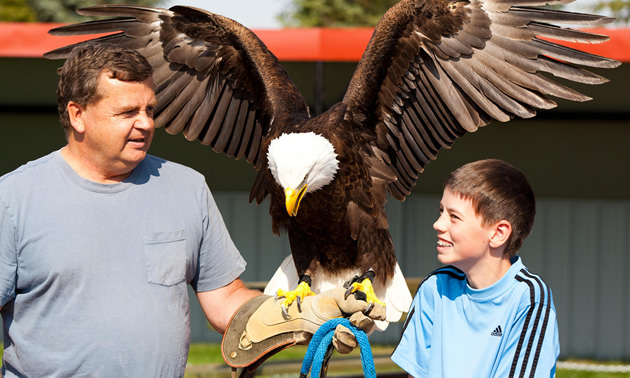
- Alberta Birds of Prey Centre. Canada’s largest birds of prey facility, which rehabilitates and releases injured birds of prey. Here you can see flying demonstrations where many birds are turned completely loose as part of their daily training and exercise.
- The Exploration Place, Prince George, British Columbia. Explore 30 species of critters including snakes, salamanders, a rosy haired tarantula and a wide variety of lizards.
- Yukon Wildlife Preserve, Whitehorse, Yukon. A unique wildlife-viewing property featuring 10 species of northern Canadian mammals in their natural environment.