
“9-1-1, what is your emergency?”
You won’t forget making this call. Neither will you forget the feeling of relief once help is on the way. The dispatcher keeps you on the phone, providing updates on ambulance or police progress. They ask you key questions and relay the answers to the team on its way so it can prepare for what they will find at the scene. You stay on the line with the dispatcher until help arrives at your door. More relief occurs when the professionals have got this as they ask you to step back.
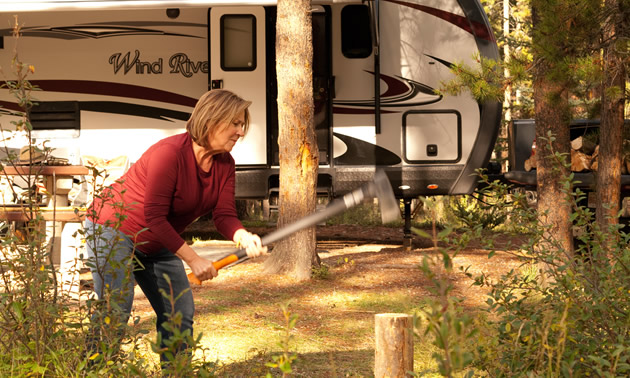
Now, consider this. It’s been a busy week. You and your partner successfully park your rig, pour drinks, unfold chairs and set up near the firepit. You announce that you are going to take the dog for a short walk, and your partner says she’ll cut some wood and promises to have the fire blazing by the time you return.
The dog is happy to stretch his legs. As you head back, you can’t smell smoke. When you round the last turn into your campsite, you can see your partner face down, partially covering the axe. You call their name. Nothing.
You shout out for help but there is no response. You punch 9-1-1 into your phone and push send. Nothing—no service.
Are you trained to deal with what needs to happen next? Do you have the tools, materials, equipment and skills to assess the casualty, administer first aid and get help?
Take the training
St. John Ambulance delivers three levels of Wilderness First Aid Training from their Edmonton branch. (Check the website for course schedules nearest your location.) Each level adds skills to deal with casualties that happen off the grid. Courses are delivered in person to provide participants hands-on practice dealing with a variety of field situations. Regular First Aid training is designed to give participants the skills necessary to provide immediate care to a casualty until emergency medical services arrive. Wilderness First Aid provides additional training to help you prepare to assist a casualty when help is hours or even days away.
Given that the whole point of camping is to “get away,” often campers are well away from 9-1-1 service areas or even out of cell range altogether. Hikers, quadders, sledders, climbers, fishers and hunters all seek time well away from 9-1-1 service areas. And all of these activities present risk of injury.
St. John Ambulance Wilderness First Aid Training teaches participants basic first aid skills with the added consideration of remote location and delayed response for assistance. Something as simple as a sprain that happens in the backyard doesn’t require you to build a fire and a suitable shelter, but depending on the situation and remote location, those two skills may tip the scale toward making it out alive. The skills to make a fire and build shelter are no less important than the skills to administer first aid.
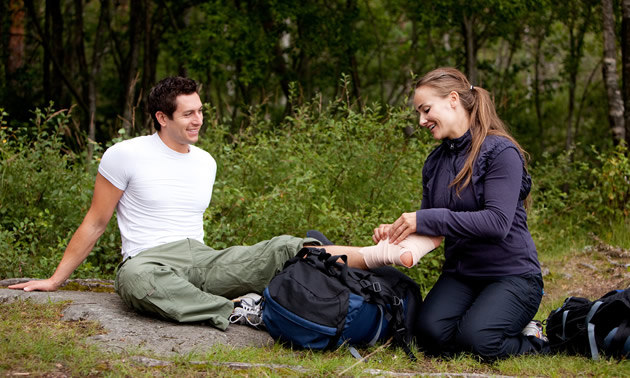
Assemble the kit
St. John Ambulance has a variety of first aid kits available for sale, covering everything from a pocket or backpack kit to ones appropriate for a cabin, RV or basecamp. Select the best first aid kit for your activity and situation and get the training so you know how to use every piece in the kit with confidence.
Among the tips you will learn are the multiple uses for each piece you carry. Consider the use of the triangle bandage: it can be deployed in multiple formats as a sling; it can be used to secure bandages; it can be made wet and placed around the neck to help cool a casualty; it can be used as a head covering; it can be made into a pouch to collect kindling; and so on. (It is worth noting that a fashionable version of a triangle bandage is worn around the neck of Boy Scouts as part of the scout uniform.)
The first aid kit container in my backpack is a coffee tin that holds my survival supplies. That tin may be used to collect drinking water, to boil liquids or to serve as a makeshift shovel. The can protects the contents from crushing and gives me multiple options for its use in the field.
St. John Ambulance’s workbooks and supplemental material provided with the course are good reference material and contain lists for what should be in your first aid kit as well as additions you should make to increase your chances of survival. The Knots and Whatnots book contains detailed instructions on important topics such as these:
- Pre-trip planning
- Tying a variety of knots and lashings
- Starting a fire
- Building a shelter
- Signalling in an emergency
- Improving your chances of being found should you get lost.
Camping season is well underway. Are you prepared to deal with a first aid emergency in a remote area where emergency services are not accessible? Book a day with St. John Ambulance to refresh your first aid skills.
The life you save could be your own.
St. John Ambulance supplemental publication Knots and Whatnots: First Aid in the Wilderness lists the following items as a basic first aid kit:
- 2 pairs latex gloves
- Artificial Respiration (A.R.) barrier mask
- tweezers
- scissors
- 2 triangular bandages
- 1 roll adhesive tape
- 2 emergency blankets
- 4 antiseptic towelettes
- 4 large gauze pads
- 4 - 2” x 2” gauze pads
- 1 - 2” pressure bandage
- 1 - 4” pressure bandage
- 1 - 6” pressure bandage
- 1 - 3” x 5” roller gauze
- Mole skin
- 20 - 3” steri-strips
- 20 - 4” steri-strips
- 5 medium safety pins
- Assorted bandages
- Non-stick sterile bandages
Consider these options:
- 2 large fabric fingertip dressings
- 2 knuckle bandages
- 1 tube antibiotic ointment
- Epinephrine injector (commonly sold as Ana-Kit or EpiPen)
- Antihistamine tablets
St. John Ambulance recommends these additions for a family pack:
- 1 bottle insect repellant
- 1 light weight splint
- 12 large gauze pads
- 1 packet of salt
- 2 pairs latex gloves
- 1 roll adhesive tape
- 12 antiseptic towels
- 1 pencil
- A small bar of soap or tube of liquid soap
- 6 triangular bandages
- 1 tooth brush
- 1 thermometer
- 2 - 2” pressure bandage
- 2 - 4” pressure bandage
- 2 - 6” pressure bandage
- 2 - 2” roller gauze
- 2 - 4” roller gauze
- Additional assorted bandages